TLDR; Teleoperate at 50 Hz. Collect 2 minutes of play data. Deploy the same policy up to 5× faster.
Imitation policies trained on teleoperated demonstrations succeed on a broad range of manipulation tasks, but their execution speed is typically capped by the frequency at which human demonstrations are collected. Naively raising the execution frequency at deployment fails, as the tracking error between commanded and reached joint positions grows with frequency, so the executed trajectory deviates from the demonstration and the policy's observations fall out of distribution.
We present Speed on Demand, a framework that enables a BC policy to operate faster than the demonstration by learning intentionally offset commands whose reached positions match the demonstrated trajectory after passing through the robot–controller dynamics. A neural dynamics model, trained using only 2 minutes of play data, captures the command-to-reached-state mapping of the robot–controller system. By fine-tuning the BC policy with this neural dynamics model in the loop, the policy learns to produce intentionally compensated commands whose resulting reached positions match the demonstrated trajectory under accelerated execution.
A single policy, conditioned on a continuous speedup factor, executes at up to 5× the demonstration frequency on CRANE-X7 with 80% task success, where both baselines fall to 27% or below. On Franka Research 3 with impedance control, the same method reaches 3.8× the demonstration frequency, and task success is preserved up to 2.5×.
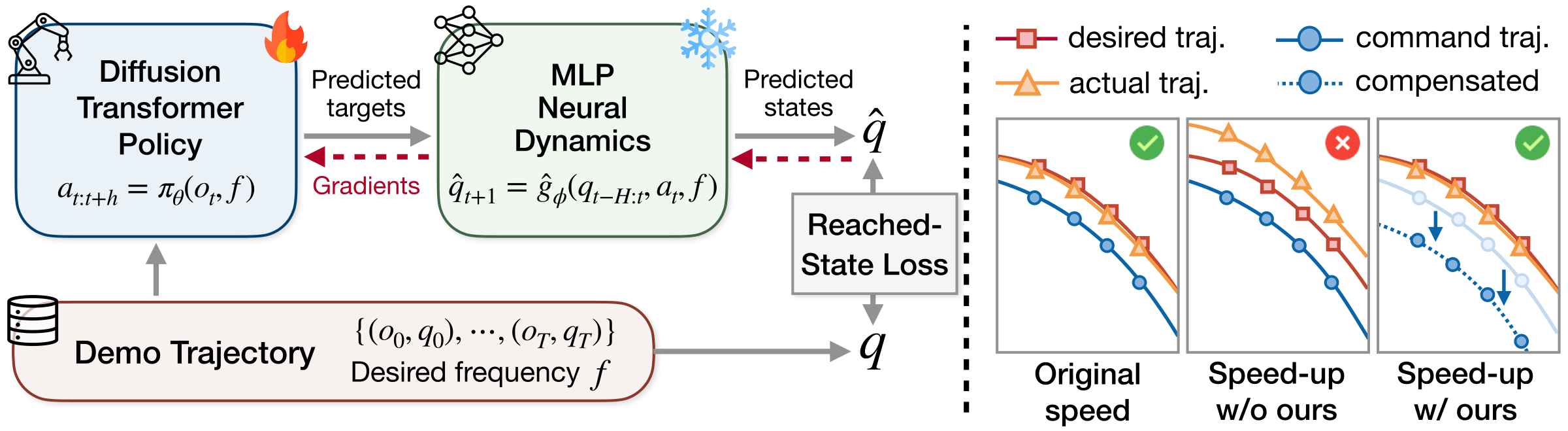
Dynamics-aware fine-tuning. Left: the trainable policy πθ predicts a chunk of joint targets from the observation and the desired speedup. The frozen neural dynamics model ĝφ maps each target to the joint position the robot will reach at that control frequency. The reached-state loss ℒreach between predicted and demonstrated joint positions is backpropagated through ĝφ into πθ (red dashed arrows). Right: at the demonstration frequency, the reached trajectory (yellow triangles) follows the desired trajectory (red squares). At a higher frequency, the uncompensated command (blue circles) is tracked with a lag and the reached trajectory deviates. The fine-tuned policy commands targets offset from the desired trajectory, so the reached trajectory matches it again.
